


What is ETFs vs. Managed Funds (MAM/PAMM): The 2026 Investor’s Guide
Last Updated: July 29, 2026 This article is reviewed annually to reflect the latest market regulations and trends TL;DR (Too Long, Didn’t Read): ETFs (Exchange-Traded Funds): These are passively managed baskets of assets that you buy and sell like stocks. They are best for hands-on investors seeking low costs, high liquidity, transparency, and direct control over...
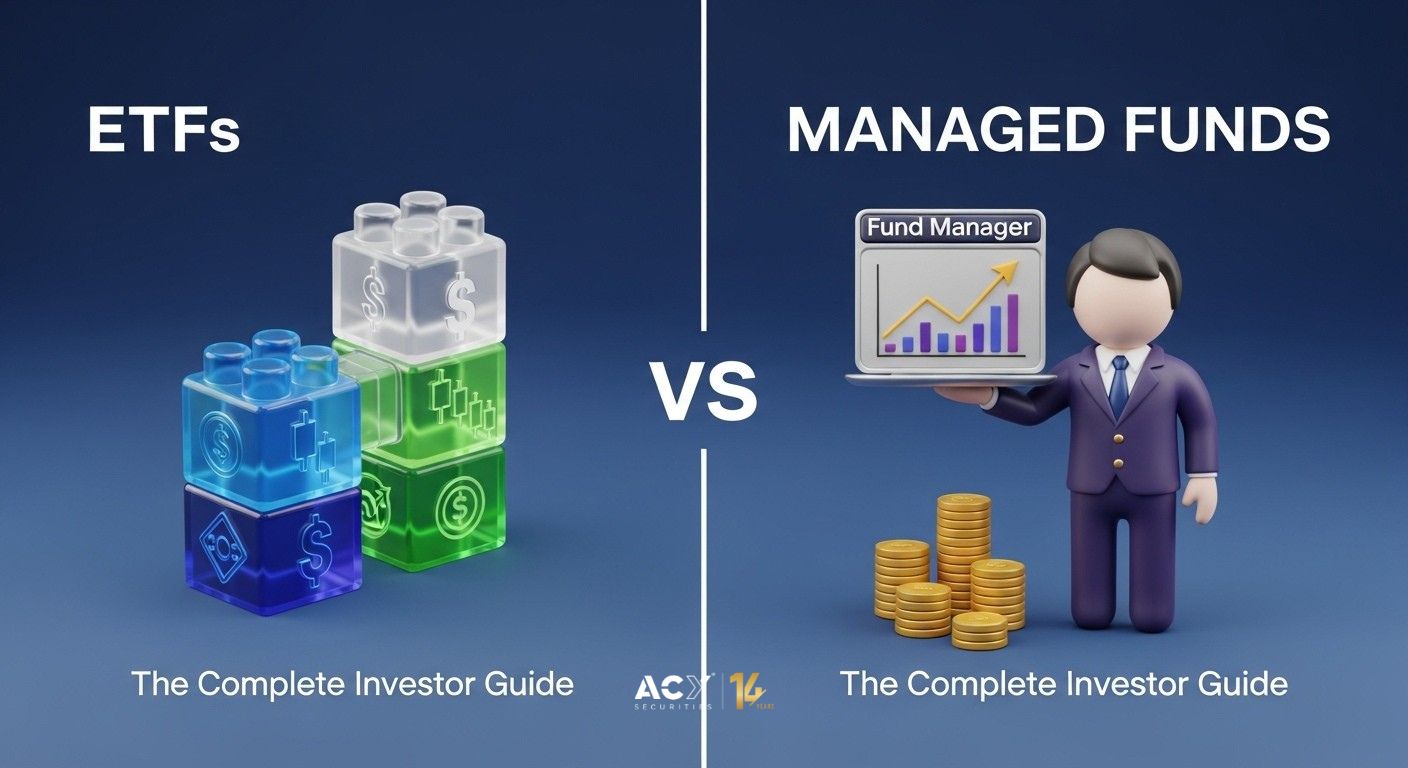
Last Updated: July 29, 2026
This article is reviewed annually to reflect the latest market regulations and trends

TL;DR (Too Long, Didn’t Read):
-
ETFs (Exchange-Traded Funds): These are passively managed baskets of assets that you buy and sell like stocks. They are best for hands-on investors seeking low costs, high liquidity, transparency, and direct control over their portfolio.
-
Managed Funds (MAM/PAMM): These are actively managed by a professional Fund Manager who makes trading decisions for you. They are ideal for passive, hands-off investors who value expert oversight and are willing to pay higher fees for potential outperformance.
-
Control & Management: With ETFs, you are in full control of buying and selling. With Managed Funds, you delegate control to an expert fund manager. This is the core difference between active and passive investment strategies.
-
Cost Structure: ETFs are known for their very low expense ratios (fees). Managed Funds have higher fees, typically combining management and performance fees to compensate the expert.
-
The Right Choice: Your decision depends on your investment goals, desired level of involvement (control), and risk appetite. There is no single “best” option, only the one that aligns with your personal investment philosophy.

“The stock market is a device for transferring money from the impatient to the patient.” – Warren Buffett
ETFs vs. Managed Funds (MAM/PAMM): The 2026 Investor’s Guide to Choosing
Are You an Architect or a Passenger on Your Investment Journey?
In the world of investing, two powerful avenues constantly vie for your capital: Exchange-Traded Funds (ETFs) and Managed Funds. Both offer the compelling promise of portfolio growth, yet they operate on fundamentally different philosophies. Choosing the wrong one is like trying to build a skyscraper with a garden shovel, it’s a frustrating misuse of a good tool.
Are you the type of investor who wants to be the architect of your own portfolio, meticulously selecting each component and controlling every decision? Or are you a passenger, preferring to trust an expert pilot to navigate the complexities of the market while you focus on the destination?
This guide will eliminate the confusion. We will dissect ETFs and Managed Funds (specifically sophisticated models like MAM and PAMM), place them side-by-side in a clear comparison, and empower you to choose the path that aligns perfectly with your financial goals, risk tolerance, and desired level of control. Let’s determine if you should be in the driver’s seat or riding shotgun.
1. ETFs: The Modern Investor’s Building Blocks

What is an ETF? An Exchange-Traded Fund is a basket of assets, such as stocks, bonds, or commodities, that trades on a stock exchange, just like a single stock. If you buy a share of an S&P 500 ETF, for instance, you are instantly buying a small piece of all 500 companies in the index. It’s instant diversification in a single transaction.
How do they work? Most ETFs are passively managed. They don’t try to beat the market; they aim to be the market by tracking a specific index. This passive nature is the key to their greatest advantages: low costs and simplicity.
Modern investors can easily access a wide variety of ETF trading products, covering everything from major global indices to specific sectors like technology or energy. These instruments are readily available on powerful platforms, with trading on MetaTrader 5 being a popular choice for its advanced charting tools and seamless execution.
-
Pros:
-
Low Cost: Passive management means lower overhead, resulting in very low expense ratios (fees).
-
Transparency: You can see the exact holdings of an ETF at any time.
-
Liquidity & Control: You can buy and sell ETFs throughout the trading day at live market prices, giving you complete control.
-
Diversification: Instantly spread your risk across dozens or hundreds of assets.
-
-
Cons:
-
You’re in Charge: The lack of active management means you are responsible for all buy and sell decisions.
-
Market Risk: If the index an ETF tracks goes down, the ETF’s value will go down with it. It offers no protection from broad market downturns.
-
Who are ETFs best for? The cost-conscious, hands-on investor who wants direct control, transparency, and a simple way to build a diversified portfolio.
2. Managed Funds (MAM/PAMM): The “Done-For-You” Professional Service

What is a Managed Fund? A managed fund is a pool of capital collected from multiple investors and managed by a professional Fund Manager. Unlike passive ETFs, these funds are actively managed. The manager uses their expertise, research, and strategy to actively buy and sell assets with the goal of outperforming the market.
In the world of modern forex and CFD trading, this concept has evolved into highly sophisticated systems like PAMM and MAM.
-
PAMM (Percentage Allocation Management Module): This is the classic pooled-fund model. Your money is combined with other investors’ funds, and the manager trades the entire pool as one. Profits and losses are distributed automatically based on the percentage you contributed. It’s a straightforward system, and understanding the nuances between MAM vs. PAMM is a key first step for any potential investor.
-
MAM (Multi-Account Manager): This is a more advanced evolution. While the manager still trades from a master account, the what a MAM account is and does is offer far more flexibility. It allows the manager to allocate trades differently to various sub-accounts, tailoring risk and strategy to individual investor needs.
-
Pros:
-
Expert Management: You benefit from the knowledge and full-time dedication of a professional trader.
-
Hands-Off Approach: It’s a true “set-it-and-forget-it” solution, saving you immense time and effort.
-
Potential for Outperformance: The primary goal is to generate returns that beat the market average.
-
-
Cons:
-
Higher Fees: Active management requires compensation. Expect to pay both a management fee and a performance fee (a percentage of the profits).
-
Less Control: You are delegating all trading decisions to the manager.
-
Less Transparency: You receive periodic reports rather than seeing every trade in real-time.
-
Who are Managed Funds best for? The passive investor who lacks the time or expertise to manage their own portfolio and is willing to pay higher fees for professional oversight.
The Ultimate Comparison: ETFs vs. Managed Funds (MAM/PAMM)
Your investment objectives, risk appetite, and desire for control are paramount. This table breaks down the core differences to help you make a well-informed decision.
| Feature | ETFs (Exchange-Traded Funds) | Managed Funds (MAM/PAMM) |
| Management Style | Passive: Tracks a market index. You make all buy/sell decisions. | Active: A professional Money Manager actively trades to beat the market. |
| Investor Control | Highest: Full control to buy or sell your ETF shares at any time during market hours. | Lowest: You delegate all trading decisions to the manager. Funds are committed. |
| Cost & Fees | Very Low: Typically low annual expense ratios. | High: Involves management fees and performance fees paid to the manager. |
| Transparency | Highest: Holdings are publicly disclosed daily. | Lower: Transparency is through periodic statements and reports from the manager. |
| Best For | Hands-on, cost-conscious investors. | Hands-off investors seeking expert management. |
| Risk Profile | You assume full market risk. The value moves with its underlying index. | Risk is determined by the manager’s strategy. Can be aggressive or conservative. |
Guiding Others to the Right Choice

Understanding these financial instruments isn’t just for personal investing. For those in the financial education or affiliate space, the ability to clearly explain these concepts is a cornerstone of building trust. A potential client who feels understood is more likely to become a long-term partner.
This knowledge forms the bedrock of any good forex affiliate marketing strategy. By creating valuable content that compares complex products like ETFs and Managed Funds, you position yourself as an authority. This is a powerful method for how to get your first 5 forex clients, you lead with value, not a sales pitch. Whether you’re using a blog or a guide to marketing on YouTube & TikTok, clear, educational content is what attracts and retains an audience.
Your Decision, Your Portfolio, Your Future
There is no “winner” in the battle of ETFs versus Managed Funds. The champion is the one that fits your life.
-
Choose ETFs if: You enjoy research, want to be in the driver’s seat, and believe that low cost is the key to long-term success.
-
Choose Managed Funds if: You value your time, believe in professional expertise, and want a partner to manage your investments for you.
Ultimately, the power of a great brokerage is providing access to both paths. At ACY, we empower you with choice, offering a robust platform for ETF trading for the self-directed investor and sophisticated MAM/PAMM solutions for those who prefer a managed approach.
The most important step is the first one. Do your due diligence, assess your personal goals, and build a portfolio that lets you sleep soundly at night.
Frequently Asked Questions
Q1: What is the main advantage of an ETF over a managed fund?
The main advantage of an ETF is its significantly lower cost. Because most ETFs are passively managed, their annual expense ratios are a fraction of the management and performance fees charged by actively managed funds. This cost difference can have a substantial impact on long-term returns.
Q2: Can you lose money in ETFs?
Yes, you can absolutely lose money in an ETF. An ETF’s value is tied directly to its underlying assets. If you own an S&P 500 ETF and the S&P 500 index falls by 10%, the value of your ETF will also fall by approximately 10%.
Q3: Are managed funds worth the high fees?
This is a central debate in investing. A managed fund is worth the high fees only if its manager can consistently outperform the market after fees are deducted. While some managers succeed, studies show that a majority of active managers fail to beat their benchmark index over the long term.
Q4: Which is better for a beginner, an ETF or a managed fund?
For most beginners, a broad-market ETF is often considered a better starting point. It offers instant diversification and low costs, and it’s easy to understand. It allows a beginner to get started in the market without having to vet the complex strategies of an active manager.
For more detailed insights on developing daily trading routines, risk management, and effective position sizing strategies, explore additional articles on ACYPartners. Our experts at ACY and FinLogix are also great resources to guide your journey towards trading excellence.
Discover Our Best Gold Affiliate Program
At ACYPartners, you can browse through a selection of affiliate program and review offerings before you decide to start forex affiliate marketing.
Become An Introducing Broker
Share your expertise and become an introducing broker so you can help other traders about the benefits of joining ACY.
Stay tuned to our blog for more Forex Affiliate Marketing educational resources.
Trading involves risks.
Related Forex Affiliate Marketing blogs:
- Best Forex Affiliate Program 2025 | Top FX Affiliate Network
- Best Gold Affiliate Program: High Paying Affiliate Program for Traders
- How a Forex CPA Affiliate Program Works with a Forex Broker – What You Must Know
- How to Choose the Right Multi Account Manager Software on MetaTrader 4 (MT4)
- 10 Reasons to Use Free Financial Widgets on Your Forex Affiliate Website
- What is a MAM Account – Forex MAM and PAMM Managed Accounts
- Introducing Broker Program (IB) Business Model & How to Be Competitive
- Benefits of the ACY Forex White Label Offering



E-book




Tài chính thế giới
Chương trình Đối tác tốt nhất Úc 2020
Úc
1300 729 171
Quốc tế
+61 2 9188 2999
partners@acy.com
CẢNH BÁO RỦI RO: Giao dịch ngoại hối và các công cụ phái sinh có mức độ rủi ro cao. Trước khi bạn quyết định giao dịch ngoại hối, chúng tôi khuyến khích bạn xem xét các mục tiêu đầu tư, mức độ chấp nhận rủi ro và kinh nghiệm giao dịch của bạn. Bạn có thể mất nhiều hơn khoản đầu tư ban đầu của bạn, vì vậy đừng đầu tư số tiền mà bạn không thể để mất. ACY Securities Pty Ltd (AFSL: 403863) và ACY Capital LLC (Company number: 2610 LLC 2022) chúng tôi cung cấp mục tiêu chung và không liên kết với mục tiêu cá nhân, tình hình tài chính hoặc nhu cầu của bạn. Nội dung của trang web này không được hiểu là lời khuyên cá nhân; vui lòng tìm kiếm lời khuyên từ một cố vấn tài chính hoặc thuế độc lập nếu bạn có bất kỳ câu hỏi nào. FSG và PDS được cung cấp theo nhu cầu hoặc đăng ký. Nếu có bất kỳ lời khuyên nào trên trang web này, thì đó chỉ là lời khuyên chung.
ACY Securities Pty Ltd (ACY AU) được ủy quyền và quản lý bởi Ủy ban Đầu tư và Chứng khoán Úc (ASIC AFSL:403863). Địa chỉ đăng ký: Tầng 18, 799 Pacific Hwy, Chatswood NSW 2067. AFSL cấp phép cho chúng tôi cung cấp dịch vụ của mình cho Cư dân hoặc Doanh nghiệp Úc.
ACY Capital LLC ('ACY LLC'), ACY LLC được thành lập tại St Vincent và Grenadines (Số công ty: 2610 LLC 2022). Địa chỉ đăng ký: Suite 305, Trung tâm Công ty Griffith, Beachmont, Kingstown.
Đối với khách hàng Jordan, Công ty Chứng khoán và Đầu tư Al Bilad (Số đăng ký: 397, Số tổ chức: 200027569), có trụ sở tại Tòa nhà số 11, Đường Paris, Al Swifeyeh, Amman, Jordan (Al Bilad), đóng vai trò là nhà môi giới giới thiệu cho ACY Capital Australia LLC (Số công ty: 2610 LLC 2022). Al Bilad được Ủy ban Chứng khoán Jordan cấp phép cung cấp các dịch vụ tài chính bằng cách giới thiệu khách hàng Jordan đến các nhà môi giới nước ngoài, trong khi ACY LLC vẫn là đơn vị chính và nhà phát hành các sản phẩm của mình.
© 2018 - 2026 ACY Securities là thương hiệu của ACY Securities Pty Ltd và ACY Capital LLC. Tất cả quyền được bảo lưu.