


How to Become a Forex Fund Manager & Build Multiple Revenue Streams?
Last Updated: October 08, 2025 This article is reviewed annually to reflect the latest market regulations and trends How to Become a Forex Fund Manager & Build Multiple Revenue Streams? Profitable trading is a skill. But turning that skill into a scalable, multi-faceted business is an art. Many traders think the only way a...
Last Updated: October 08, 2025
This article is reviewed annually to reflect the latest market regulations and trends

How to Become a Forex Fund Manager & Build Multiple Revenue Streams?
Profitable trading is a skill. But turning that skill into a scalable, multi-faceted business is an art. Many traders think the only way a fund manager earns is from a percentage of profits. This is a critical, wealth-limiting mistake. The most successful fund managers don’t build a job; they build an enterprise with multiple, independent revenue streams. This transition represents the pinnacle of a trader’s career, moving from individual success to entrepreneurial leadership in the world’s largest financial market. Understanding the top three benefits of being a forex money manager is the first step toward appreciating this powerful career shift.
This article is a blueprint for traders who want to become a forex fund manager who thinks like a CEO, architecting a business with a diversified income model. We will explore the multifaceted role of a forex fund manager, demystify what a forex managed fund is, and provide a step-by-step blueprint for launching your own fund management business. For ambitious traders, the path to becoming a money manager is a natural progression that rewards expertise with scalability and the chance to build a real business. If you’re at a crossroads, this honest guide to your next career can help clarify whether the fund manager or affiliate path is right for you.
TL;DR (Too Long; Didn’t Read)
-
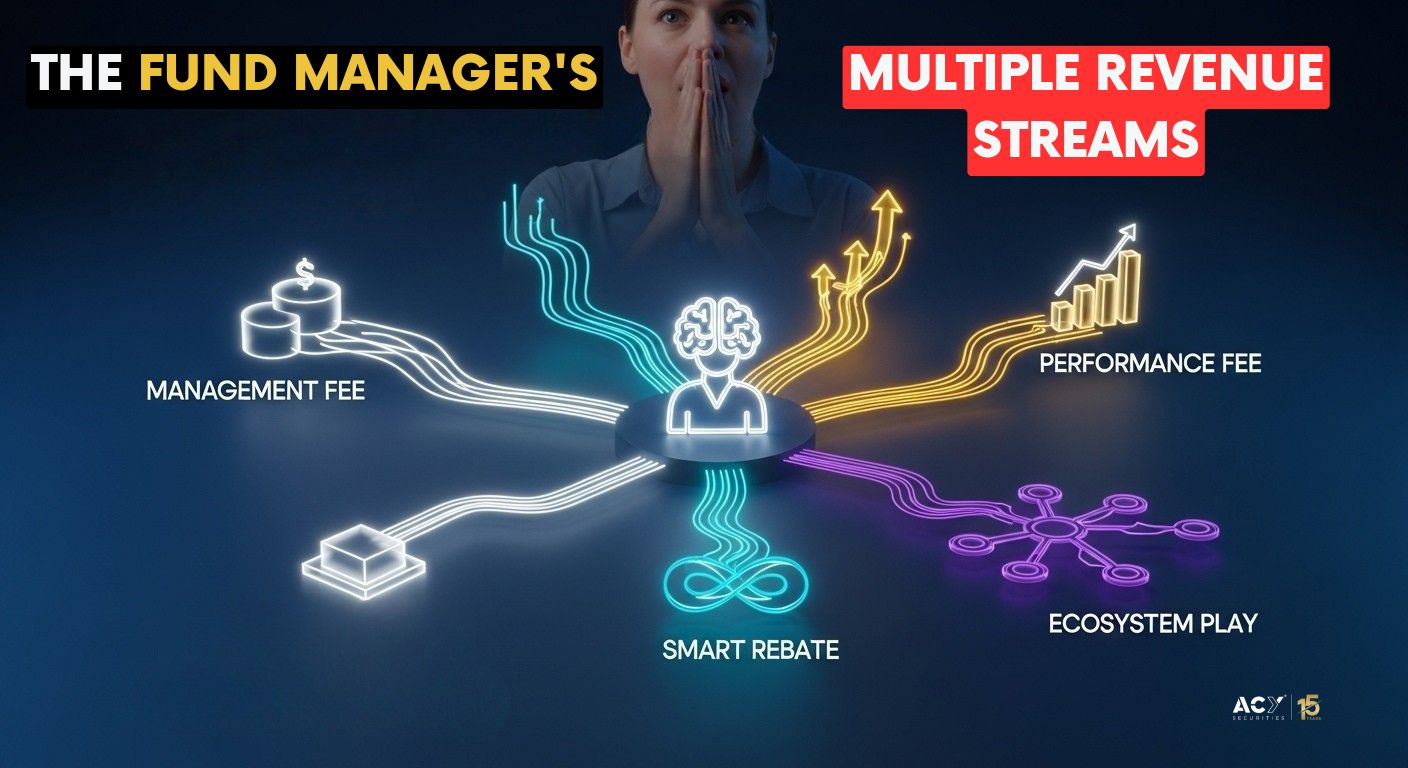
Management Fee (The Foundation): A stable, predictable income based on a small percentage of your Assets Under Management (AUM), providing operational cash flow.
-
Performance Fee (The Upside): Your reward for excellence. A significant percentage of the profits you generate, protected by a “high-water mark” to ensure fairness.
-
“Smart” Rebates (The Hidden Engine): The professional strategy of operating as an IB for your own fund, earning recurring rebates on your fund’s trading volume.
-
Ecosystem Commissions (The Value-Add): Generating affiliate income by referring your clients to trusted, complementary services, enhancing your value and revenue.
The Four Pillars of Your Fund Management Enterprise
To build a resilient and scalable business, a successful forex fund manager must move beyond relying solely on performance. Diversifying your income is not just a strategy for growth; it’s a defensive measure that ensures longevity in a volatile market. Here, we break down the four essential revenue streams that form the foundation of a modern fund management enterprise.
Revenue Stream #1: The Management Fee (Your Stability)

The management fee is the bedrock of your fund’s financial stability. It is a predictable, recurring income stream calculated as a small percentage of your total Assets Under Management (AUM). Typically, this fee ranges from 1-2% of AUM annually, billed to clients on a monthly or quarterly basis.
Think of the management fee as the salary you pay your business. It covers your operational expenses, rent, utilities, software subscriptions, marketing costs, and legal counsel, regardless of your fund’s monthly performance. This stability is crucial, especially during periods of market consolidation or drawdown. While performance fees provide the significant upside, the management fee keeps the lights on and allows you to focus on your trading strategy without the pressure of short-term profitability. For clients, the management fee is the cost of your expertise, your infrastructure, and your commitment to managing their capital with professionalism and diligence.
Revenue Stream #2: The Performance Fee (Your Reward)

The performance fee is the most direct and powerful incentive for a fund manager. It is your reward for generating profits and directly aligns your interests with those of your clients. The industry standard, often referred to as “2 and 20,” consists of a 2% management fee and a 20% performance fee. This 20% is calculated on new profits generated by the fund.
A critical component of a fair performance fee structure is the high-water mark. This is a clause that ensures you only get paid for new profits. If your fund’s value drops, you must recover those losses and exceed the previous peak before you can charge a performance fee again. This protects your clients from paying for volatile or inconsistent performance and builds a foundation of trust.
Example of a High-Water Mark:
-
A client invests $100,000.
-
You generate a 10% profit, bringing the account value to $110,000. The high-water mark is now $110,000. You earn a 20% performance fee on the
10,000 profit2,000). -
The market turns, and the account value drops to $105,000.
-
In the next period, you generate a 10% profit, bringing the account value to $115,500. You can only charge a performance fee on the profit above the $110,000 high-water mark, which is $5,500.
The performance fee is the most significant driver of your wealth as a fund manager, but it is also the most volatile. By combining it with a stable management fee, you create a balanced and resilient revenue model.
Revenue Stream #3: The “Smart” Rebate (Your Operational Alpha)

This is the strategy that separates the amateur from the professional. A “smart” rebate is the income you earn by acting as the Introducing Broker (IB) for your own fund. Every time you execute a trade on behalf of your clients, your broker pays you a small rebate on the trading volume. This is a standard professional practice for managers who act as the IB for their own managed funds.
Framed correctly, this is not a conflict of interest but a sophisticated business decision. By capturing these rebates, you are essentially lowering your operational costs and increasing your profitability. This additional income stream can be used to reinvest in your business, improve your technology, or expand your marketing efforts. The key is transparency. Your clients should be fully aware of this arrangement, and it should not negatively impact their execution costs. A partner with the best marketing support will help you manage both your fund and IB activities seamlessly. For a deeper understanding of the underlying model, it’s worth exploring the forex strategy of how traders earn through affiliate marketing.
Revenue Stream #4: The Ecosystem Play (Your Affiliate Side-Hustle)

As a trusted fund manager, you are in a unique position to recommend valuable, non-competing services to your clients. This creates an “ecosystem” around your core offering and opens up an additional revenue stream through affiliate commissions. By referring your clients to services like high-performance VPS hosting, advanced trading analytics, or specialized educational courses, you can earn a commission on each sale.
This is not just about making extra money; it’s about adding value to your clients’ experience. By curating a list of trusted partners, you are saving your clients time and effort in their search for reliable tools and resources. This strengthens your relationship with your clients and positions you as a central figure in their trading journey. To learn more about building out this side of your business, consider this complete guide to building a forex affiliate business or the ultimate forex affiliate marketing strategy. When considering your options, it’s helpful to understand the different models, from the straightforward forex CPA affiliate program to more complex revenue-sharing arrangements.
How to Structure Your Fees to Be Fair and Attractive?

Your fee structure is one of the most powerful marketing tools you have. A fair and transparent fee structure will not only attract your first clients but will also help you build a long-term, sustainable business. The industry standard “2 and 20” model is a good starting point, but it’s not a one-size-fits-all solution. It’s crucial to understand the forex affiliate fees and costs to contrast them with the more complex fund manager fee structure.
The entire process is powered by technology like Multi-Account Manager (MAM) software. For a deep dive, it’s worth understanding how MAM accounts work and why fund managers love them, as this technology is what enables you to manage multiple clients and automate fee collection seamlessly.
Best Practices for Fee Structuring & Marketing:
-
Transparency is Key: Your fee structure should be clearly outlined in your client agreement. There should be no hidden fees or surprises. This is a cornerstone of learning how to promote ethically in a high-risk industry.
-
Create Compelling Content: To attract clients, you must demonstrate your expertise. A powerful way to do this is to create content that solves trader psychology problems, positioning you as a thoughtful market leader.
-
Optimize Your Website: Your online presence is your digital storefront. You can use financial widgets to increase website conversions and capture potential client leads effectively.
Ultimately, the best fee structure is one that is fair to both you and your clients. Once you’ve structured your fees, the next step is to learn how to get your first 5 forex clients.
Advanced Mindsets for Building a Financial Powerhouse
To truly excel as a fund manager, you need to think beyond the day-to-day operations of your business. You need to adopt the mindsets of the world’s most successful investors and entrepreneurs.
How George Soros Would Think About Building a Fund

George Soros’s theory of reflexivity provides a powerful framework for understanding how to build a successful fund. Soros would see a fund not just as a trading vehicle, but as a self-reinforcing machine. Strong performance (generating performance fees) builds a reputation that attracts more AUM (increasing management fees). This larger AUM allows for more significant market positions. The multiple revenue streams (fees, rebates) create a robust financial base, allowing the fund to survive downturns and press its advantage during opportunities. It’s a reflexive loop where success begets more success. This mindset extends to the strategies you employ, always looking for an edge, whether that’s a unique market insight or leveraging technology like gold AI alternatives for attracting high-value clients.
10 Lessons from “The Lean Startup” for New Fund Managers

The principles of “The Lean Startup” by Eric Ries can be applied to launching and growing a fund management business. This methodology emphasizes agility, customer feedback, and iterative development.
-
The MVP (Minimum Viable Product): Your MVP is your initial, verifiable 12-month track record on a small amount of capital. This is the core product you will use to attract your first clients.
-
Build-Measure-Learn: Build the track record, measure the performance metrics (Sharpe ratio, drawdown), and learn what your core strengths are before seeking outside capital. This is a crucial feedback loop for refining your strategy.
-
Validated Learning: Attracting your first few clients who aren’t friends or family is the ultimate “validated learning” that you have a marketable product.
-
The Pivot: If your initial strategy isn’t attracting capital, you may need to “pivot” by adjusting your risk parameters, asset focus, or fee structure based on market feedback.
-
Innovation Accounting: Don’t just focus on AUM. Track metrics like client acquisition cost, client lifetime value, and referral rates to get a true picture of your business’s health.
-
Actionable Metrics vs. Vanity Metrics: AUM can be a vanity metric if your fee structure is not profitable. Focus on actionable metrics like revenue per client and profit margin.
-
Continuous Deployment: Regularly update your clients on your performance and market outlook. This builds trust and keeps them engaged.
-
Split Testing: Experiment with different marketing messages and fee structures on a small scale to see what resonates with your target audience.
-
The Andon Cord: Have a clear risk management plan in place. If you experience a significant drawdown, have a pre-defined “Andon Cord” that you can pull to stop trading and reassess your strategy.
-
Engine of Growth: Identify your primary “engine of growth.” Is it referrals, a strong online presence, or perhaps a unique forex affiliate with an AI side hustle that generates leads? Focus your efforts on what works.
Your Top Questions on Fund Manager Revenue
Which revenue stream is the most important for a new fund manager?
The performance fee is the most important for building your reputation and wealth. However, the “smart” rebate stream is a crucial but often overlooked way to add consistent income from day one.
What is a “high-water mark” and why is it important?
It’s a clause that ensures you only get paid performance fees on new profits. If your fund drops in value, you must regain that loss before you can charge a performance fee again. It’s the industry standard for fairness.
Is it a conflict of interest to earn IB rebates from my own fund’s trades?
Not if it is fully transparent to your clients and doesn’t negatively impact their execution costs. It’s a standard professional practice for managers to act as the IB for their own managed funds.
How much capital do I need to start?
You need enough of your own capital to create a meaningful track record. The technology, like MAM accounts, is often provided by your broker partner, which significantly lowers the barrier to entry.
Should I choose a management fee or a performance fee?
The standard is both (e.g., “2 and 20”). A management fee provides stability, while the performance fee aligns your interests with your clients’ success and provides the most significant upside.
Conclusion
The most successful fund managers are not just great traders; they are great entrepreneurs. By moving beyond a single income source and intelligently building multiple revenue streams, you can transform your trading skill into a resilient, scalable, and highly profitable business enterprise. The journey begins with a proven strategy and is supported by a broker who understands the needs of a professional fund manager. If you’re ready to break through your ceiling, this is your blueprint. To take the next step, consider becoming a money manager and exploring the world of the forex managed fund. The operational side of the business, including learning how to manage multiple forex accounts the professional method, is a critical component of your success. By building a robust business, you can transform your trading skill into a legacy.
Your Path to a Smarter Trading Future Starts Now
The future of trading isn’t about replacing human intelligence but augmenting it. You now have a blueprint to take decades of trading wisdom, forge it into a powerful AI assistant, and use it to build your own trading and affiliate marketing empire.
Stop trading on emotion. Stop paying for inflexible tools. Start building your edge.
Ready to build your business and empower your clients? Join the ACY Partners Program today and start sharing your unique AI trading bot with the world.
Disclaimer:Trading Forex and CFDs involves significant risk and may not be suitable for all investors. The content of this article is for educational purposes only and should not be considered financial advice. The performance of any AI tool or trading strategy is not guaranteed. Always conduct your own research and consider your risk tolerance before trading with real capital. Ensure that when you share your app, you include this disclaimer and your ACY Partners affiliate link for any sign-ups.
For more detailed insights on developing daily trading routines, risk management, and effective position sizing strategies, explore additional articles on ACYPartners. Our experts at ACY and FinLogix are also great resources to guide your journey towards trading excellence.
Discover Our Best Gold Affiliate Program
At ACYPartners, you can browse through a selection of affiliate program and review offerings before you decide to start forex affiliate marketing.
Become An Introducing Broker
Share your expertise and become an introducing broker so you can help other traders about the benefits of joining ACY.
Stay tuned to our blog for more Forex Affiliate Marketing educational resources.
Trading involves risks.
Related Forex Affiliate Marketing blogs:
- Best Forex Affiliate Program 2025 | Top FX Affiliate Network
- Best Gold Affiliate Program: High Paying Affiliate Program for Traders
- How a Forex CPA Affiliate Program Works with a Forex Broker – What You Must Know
- How to Choose the Right Multi Account Manager Software on MetaTrader 4 (MT4)
- 10 Reasons to Use Free Financial Widgets on Your Forex Affiliate Website
- What is a MAM Account – Forex MAM and PAMM Managed Accounts
- Introducing Broker Program (IB) Business Model & How to Be Competitive
- Benefits of the ACY Forex White Label Offering



E-book




Tài chính thế giới
Chương trình Đối tác tốt nhất Úc 2020
Úc
1300 729 171
Quốc tế
+61 2 9188 2999
partners@acy.com
CẢNH BÁO RỦI RO: Giao dịch ngoại hối và các công cụ phái sinh có mức độ rủi ro cao. Trước khi bạn quyết định giao dịch ngoại hối, chúng tôi khuyến khích bạn xem xét các mục tiêu đầu tư, mức độ chấp nhận rủi ro và kinh nghiệm giao dịch của bạn. Bạn có thể mất nhiều hơn khoản đầu tư ban đầu của bạn, vì vậy đừng đầu tư số tiền mà bạn không thể để mất. ACY Securities Pty Ltd (AFSL: 403863) và ACY Capital LLC (Company number: 2610 LLC 2022) chúng tôi cung cấp mục tiêu chung và không liên kết với mục tiêu cá nhân, tình hình tài chính hoặc nhu cầu của bạn. Nội dung của trang web này không được hiểu là lời khuyên cá nhân; vui lòng tìm kiếm lời khuyên từ một cố vấn tài chính hoặc thuế độc lập nếu bạn có bất kỳ câu hỏi nào. FSG và PDS được cung cấp theo nhu cầu hoặc đăng ký. Nếu có bất kỳ lời khuyên nào trên trang web này, thì đó chỉ là lời khuyên chung.
ACY Securities Pty Ltd (ACY AU) được ủy quyền và quản lý bởi Ủy ban Đầu tư và Chứng khoán Úc (ASIC AFSL:403863). Địa chỉ đăng ký: Tầng 18, 799 Pacific Hwy, Chatswood NSW 2067. AFSL cấp phép cho chúng tôi cung cấp dịch vụ của mình cho Cư dân hoặc Doanh nghiệp Úc.
ACY Capital LLC ('ACY LLC'), ACY LLC được thành lập tại St Vincent và Grenadines (Số công ty: 2610 LLC 2022). Địa chỉ đăng ký: Suite 305, Trung tâm Công ty Griffith, Beachmont, Kingstown.
Đối với khách hàng Jordan, Công ty Chứng khoán và Đầu tư Al Bilad (Số đăng ký: 397, Số tổ chức: 200027569), có trụ sở tại Tòa nhà số 11, Đường Paris, Al Swifeyeh, Amman, Jordan (Al Bilad), đóng vai trò là nhà môi giới giới thiệu cho ACY Capital Australia LLC (Số công ty: 2610 LLC 2022). Al Bilad được Ủy ban Chứng khoán Jordan cấp phép cung cấp các dịch vụ tài chính bằng cách giới thiệu khách hàng Jordan đến các nhà môi giới nước ngoài, trong khi ACY LLC vẫn là đơn vị chính và nhà phát hành các sản phẩm của mình.
© 2018 - 2026 ACY Securities là thương hiệu của ACY Securities Pty Ltd và ACY Capital LLC. Tất cả quyền được bảo lưu.